The 2026 PANC: Top 30 Influencers, Category Leaders, and Rising Stars in People Analytics
Last year we ran the People Analytics Network Census (PANC) for the first time and we were overwhelmed by the response. Over 400 people from around the globe submitted a response and the feedback from the community was overwhelmingly positive. So we had to run it again this year! A few months ago we released the 2026 PANC, and this post is the first set of results from it.
For those who might be less familiar with the PANC, the purpose is to map the global network of People Analytics professionals and to measure how that network changes over time. Our objective is to truly understand this community and to deliver insights back to it. The PANC is run by a core team of six: Patrick Coolen (KennedyFitch), Matthew Diabes (NYU), Stephanie Murphy (Society for People Analytics), Maria Nolazco (IPSY), Andrew Pitts (Polinode), and Richard Rosenow (Ikona Analytics).
This effort would not be possible without the community, and we are grateful to our distribution partners, Directionally Correct, Insight222, People Analytics World, and the Society for People Analytics, as well as the over 40 individual PANC supporters who helped us tremendously in getting the word out.
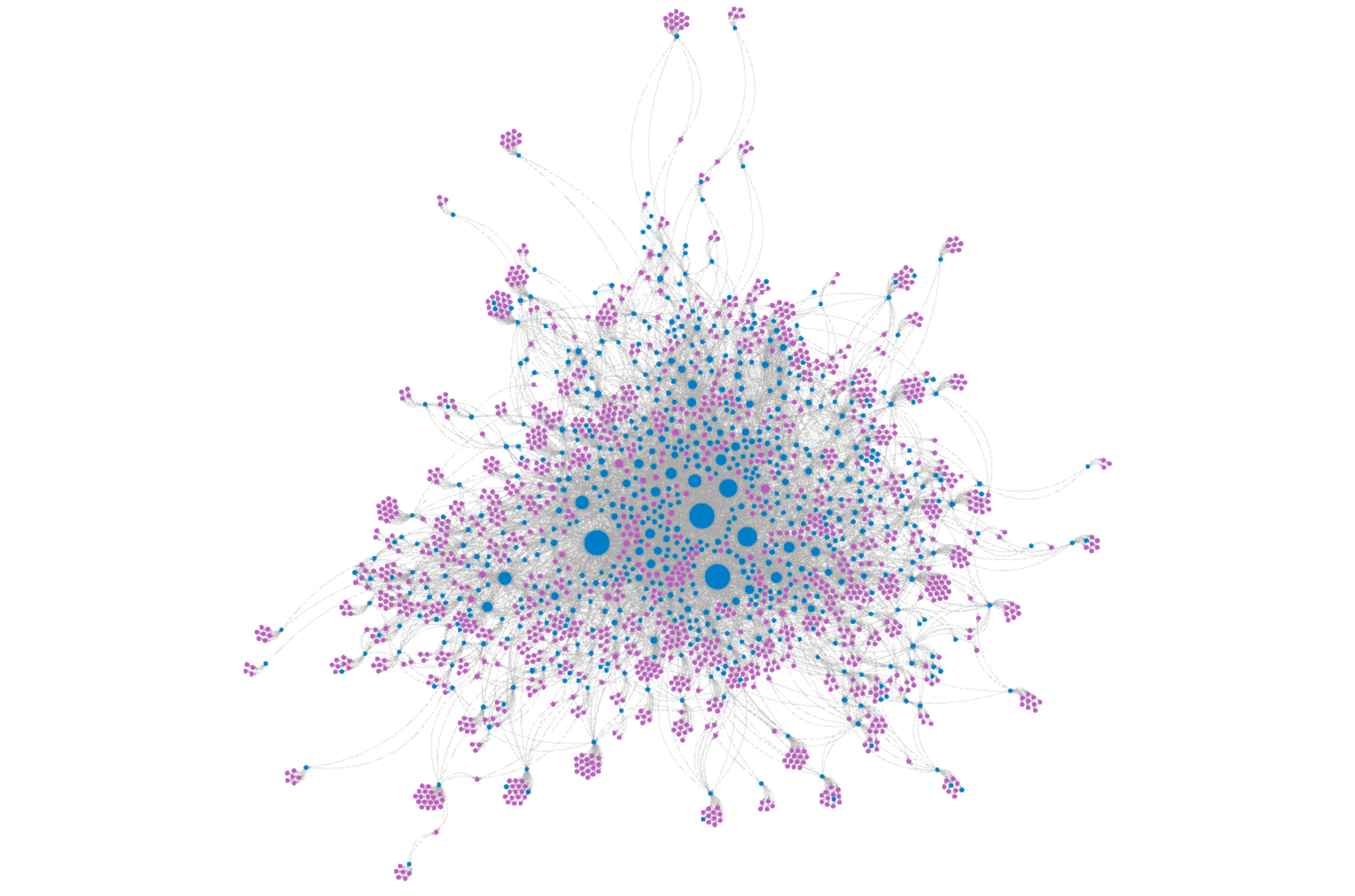
We are pleased to report that the 2026 PANC was even bigger than last year's. This year 506 people completed the survey, and between them they named a network of 3,135 unique professionals across the field. This is an incredibly rich dataset, particularly when combined with last year's responses and the attribute data we collected alongside these relationships, such as location, role, tenure, People Analytics team maturity, responsibilities and so on.
The image below shows the network that the PANC collected (well, the major connected component of it, that is). The blue nodes are respondents to the PANC and the pink nodes are people who did not respond themselves but were nominated by someone else.
The focus of this post is on the identification of different kinds of influencers in the community based on the 2026 results. This year we decided to identify four broad groups of influencers:
- Top 30 Overall Influencers
- Top 3 Country Influencers per participating country
- Top Influencers for each of Vision and Ideas, Mentorship, Technical Expertise, and Networking (the four categories explicitly measured by the PANC)
- Top 10 "Rising Stars" (new in 2026)
In each section below we explain briefly the methodology used for each group. For those interested in more of the details behind the methodology, we encourage you to take a look at the methodology paper that we produced (for the first time) this year.
One note that applies throughout: every list below is ordered alphabetically by last name, not by rank. Being named is the recognition; we are deliberately not ranking people within a list.
The Top 30 People Analytics Influencers
These are the overall influencers within the global community. For those who took the PANC, you may recall that we asked respondents to describe three networks: the people who are their key relationships inside their current organisation, at previous workplaces, and across the broader community. From those nominations we built a directed network and ranked it with a weighted version of PageRank, the same family of algorithm that once ranked the early web.
PageRank rewards being nominated by people who are themselves well connected, rather than simply counting raw nominations. We also gave more weight to the community ties. So people at the top of the list did not necessarily receive the most nominations, but were towards the top because they were named by people who are themselves influential and well connected. Remember that the names are listed alphabetically by surname, and we have included LinkedIn profile links for each one.
We also invited each of the Top 30 to answer a short question about their work and the field generally. This year we decided to give people five prompts that they could pick from:
- What keeps you in People Analytics?
- Finish the sentence: "In three years, People Analytics will..."
- What is the one thing you wish you had known when you started?
- What is the most overrated or underrated idea in People Analytics today?
- What makes the People Analytics community special?
Many answered more than one, and we have selected a single response from each person to feature below.

























What the Top 30 told us
Many of the Top 30 decided to answer all five (or at least more than one) of the prompts that we gave them. When we saw this, we decided that (a) we did not want to overload you, our reader, with all of the responses, but (b) we also did not want to throw away all of this terrific open-text data. So what to do in a situation like this? Well, naturally we fed the quotes to an LLM and asked it to extract the key themes for us. Below is a concise summary of the themes as provided by the LLM.
1. From analysis to decisions. Almost everyone defines the work by whether it changes what leaders actually do, not by the models or dashboards behind it. The ambition people describe is to be embedded in strategic workforce decisions and business workflows rather than to produce more reports. It shows up in what they call overrated too: backward-looking metrics, and dashboards mistaken for strategy. Several, including David Green and Amit Mohindra, say the lesson they learned the hard way is that trust and influence matter more than technical skill, because even the best analysis has to be acted on to count.
2. AI raises the stakes for the human side, not lowers them. Nearly everyone who looks ahead mentions AI, and the consensus is the opposite of the field being automated away. As Michael Arena puts it, as AI gets better at answering "what," the enduring value moves to answering "why." People expect the human, interpretive, and relational parts of the work, the context and judgement a model cannot supply, to become the scarce and valuable part.
3. Relationships and networks are the underrated frontier. Fittingly for a network census, several people single out social capital and the structure of relationships at work as the most underrated idea in the field. Al Adamsen argues that relationships deserve to be studied with the same rigour as human capital, and others note that companies and teams are more than a collection of individuals. It is a reminder that a lot of what drives performance sits in the connections between people, not just in their individual attributes.
4. A generous community is why people stay. When asked what makes the community special, the answers converge on an unusually open and generous culture, and the word "generosity" comes up again and again. People share their methods, their failures, and their playbooks with near-strangers and expect nothing back. Underneath it is a sense of mission, that the work is about people and about making work fairer and more humane, which is what sustains people through a period of rapid change.
Top Influencers by Country
In some future work that we will share with the community, we will be digging into the demographics and non-relational responses of respondents. Last year we found that more than half of respondents were US based. This year we made even more of a concerted effort to reach communities outside of the US, including the addition of Patrick Coolen (The Netherlands) and Maria Nolazco (Argentina) to the core team. We certainly have more non-US representation in our list of overall influencers this year, but we still believe that the PANC has an important role to play in promoting and connecting people in communities and countries outside of the US. It is for this reason that we are once again creating a list of Top Influencers by Country.
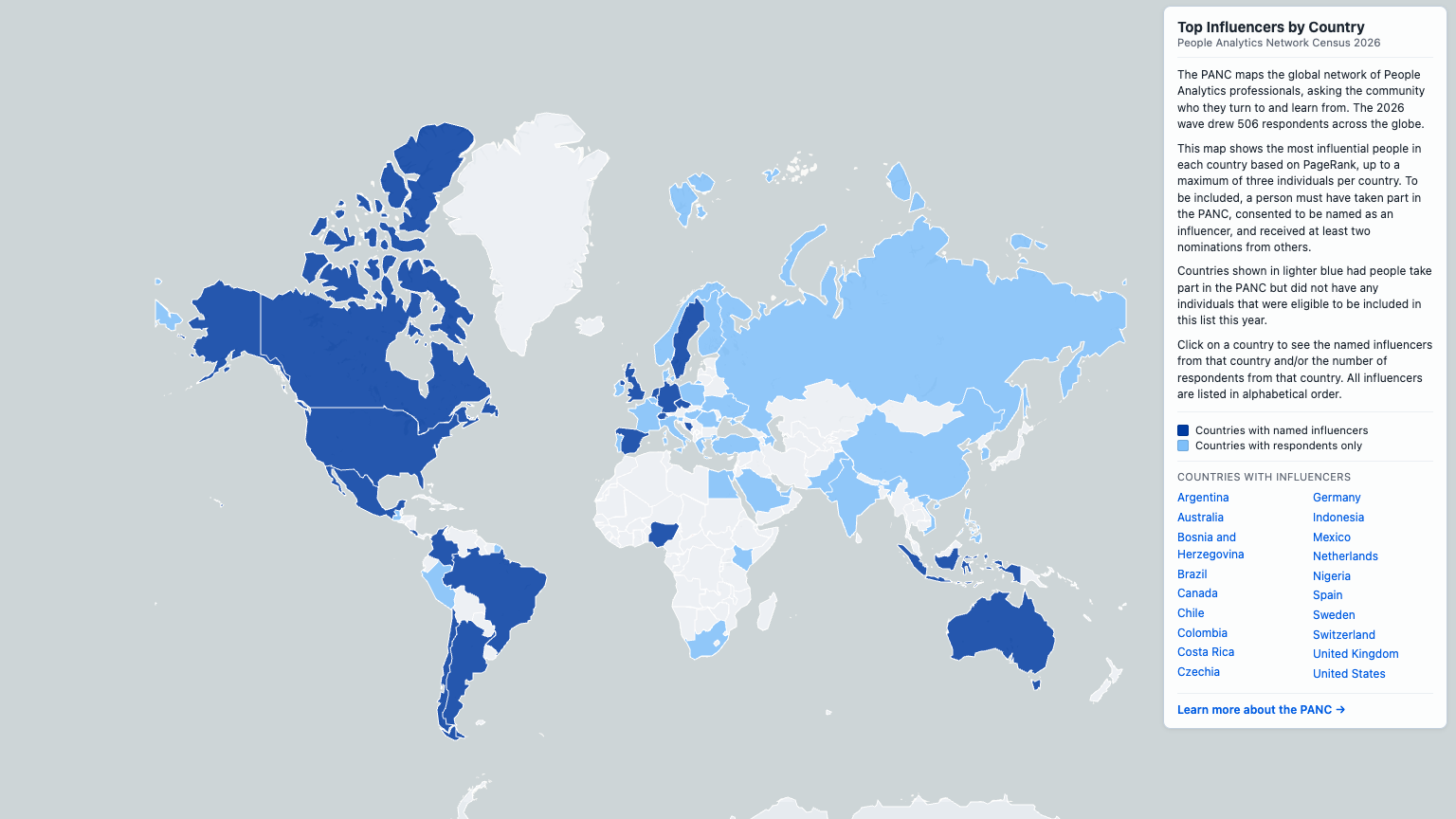
This year, instead of the top single influencer for each country, we decided to include up to three influencers for each country, and we determined this by applying the same PageRank-based method as for the Top 30 Overall Influencers. Not every country that participated has three influencers, and many countries do not have any identified influencers because we also required that each person receive a reasonable number of base nominations in order to be included. In total we identified 37 country influencers across 19 countries in this way.
Rather than share a single flat list, we have built an interactive map so you can explore the most influential professionals country by country. Click the map to explore the leaders in your part of the world.
Category Leaders
Influence is not just one thing. Some people shape how the field thinks, others quietly develop the next generation, others are the technical backbone their peers lean on, and others are the connectors who hold the whole network together. So alongside the overall list, we have identified leaders in the four categories that the PANC explicitly measured: Vision and Ideas, Mentorship, Technical Expertise, and Networking. Vision and Ideas is a new category this year.
These lists come from those labels: when people nominated someone, they could also say what they valued them for. There are two other things we did differently this year compared to last year. The first is that we adjusted for how generous or harsh each nominator was when giving out a label (for example, indicating that someone was a source of Technical Expertise for them). The second is that we have split each category into two groups: practitioners working inside an organisation, and everyone else (consultants, vendors, and academics).
We split them because, left together, the non-practitioners tended to dominate these lists. They often build their reputation on being widely known for a particular kind of contribution, so separating the two groups makes sure that practitioners are not unfairly pushed out by non-practitioners. Within each group the names are in alphabetical order, and each links to LinkedIn.
Top Vision & Ideas Influencers
The people the community looks to for strategic insight and innovative thinking, those whose thinking moves the field forward through frameworks, writing, or the questions they push everyone else to ask.
Practitioners




Top Mentorship Influencers
The people others turn to for mentorship and career advice, and who others credit with their growth.
Practitioners





Top Technical Expertise Influencers
The people others seek out for help on difficult technical questions and problems. These are the practitioners and specialists trusted for genuine technical depth.
Practitioners



Top Networking Influencers
The connectors, the people who make thoughtful introductions and help others build their networks.
Practitioners


Rising Stars
It is important to nominate people who are highly central in the network or who deliver on particular dimensions that others find valuable. But we also wanted to make sure to acknowledge newer contributions and voices. For this reason we created a new category this year called Rising Stars. To be eligible for this group you needed to have 15 years or less of total experience since joining the workforce and 8 years or less of experience in People Analytics. We selected these numbers because both were slightly less than the medians for all respondents. We then applied the same PageRank-based metric as for the overall influencers, but subject to these filters.
If you are not connected to these individuals yet, we would encourage you to connect with them!










Why isn't a particular person on the list?
One of the questions that we often received last year was "I'm surprised Person X is not on the list, why?". If someone you would have expected is missing, there are a few likely reasons. They may not have taken part in the PANC this year, since the survey can only rank people the community had a chance to nominate. They may have taken part but chosen not to be named publicly, which we always respect. Or they may have ranked just outside a threshold, which is unavoidable whenever a line has to be drawn.
None of this is a judgement about anyone's contribution. It reflects who responded, who consented, and where the cut fell in a single year of data. Also, there is no single correct methodology for identifying influencers. We have refined our approach from last year and will likely continue to do so.
And if you were hoping or expecting to be on one of the lists and were not, please know that there are many people who have made, and will continue to make, amazing contributions to the community and who are not named here. Your contributions are still seen and appreciated.
Why identify influencers at all?
The point is not to rank people for its own sake. A field grows faster when it is easy to find the people that others have found particularly helpful, and that is especially true for newcomers trying to get their bearings. Peer nomination is also a fairer basis for recognition than the usual signals, because it reflects who the community actually relies on rather than the more subjective measures that are more commonly used. And by returning the analysis to the community, we hope to make the network a little easier to navigate for everyone in it.
A note on our own influence
Several of the core team appear on these lists. By reaching out to a broad group of over 40 supporters to promote the PANC, we tried to reach as many people as we could and to dilute the bias that certainly must exist through our own participation in and promotion of the PANC. We acknowledge, though, that there is almost certainly some residual bias that remains. Our most important job is to report the results as they are, and hopefully as the PANC continues to grow in awareness and size, the bias introduced by our own participation will continue to decline.
What comes next
We promised three things at the start of the PANC, and two more are still to come.
First, we are still planning to put on a webinar walking through the wider results of the 2026 PANC. The lists in this post are the headline, but the census tells a much richer story about how the People Analytics community is structured, how it is connected, and how it is changing. We will email everyone who took part in the PANC with details of the webinar soon.
Second, we are planning to produce personal network reports for those who participated in the PANC, as we did last year (last year we produced them for people who received a threshold number of nominations, and we are hoping to go broader this year).
Thank you to everyone who participated in the PANC this year! This is only possible with your support and participation. And if you did not participate and would like to next year, you can register your interest by signing up here.